
PM Surya Ghar solar subsidy: what it covers and how to claim it
PM Surya Ghar reduces the cost of a residential rooftop system. The scheme is genuinely worth claiming: most of the difficulty is in the process, not the eligibility.
Please note: the subsidy is paid only for systems installed by a vendor registered with your DISCOM on the National Portal. Origian Power is not a registered PM Surya Ghar vendor, so a system we install does not qualify for this subsidy. This page explains how the scheme works so you can decide.
In brief
- PM Surya Ghar is a central government subsidy for residential rooftop solar that is grid-connected with net metering.
- You pay the full system cost first. The subsidy is credited to your bank account after installation, DISCOM inspection and net metering are complete.
- You need a domestic electricity connection, the right to install on the roof, and no earlier rooftop solar subsidy claimed on that connection.
- The amount depends on system size and is capped at the 3 kW-and-above band. Beyond that, extra capacity is paid for in full.
- The PM Surya Ghar portal is the authoritative source for current amounts and rules.
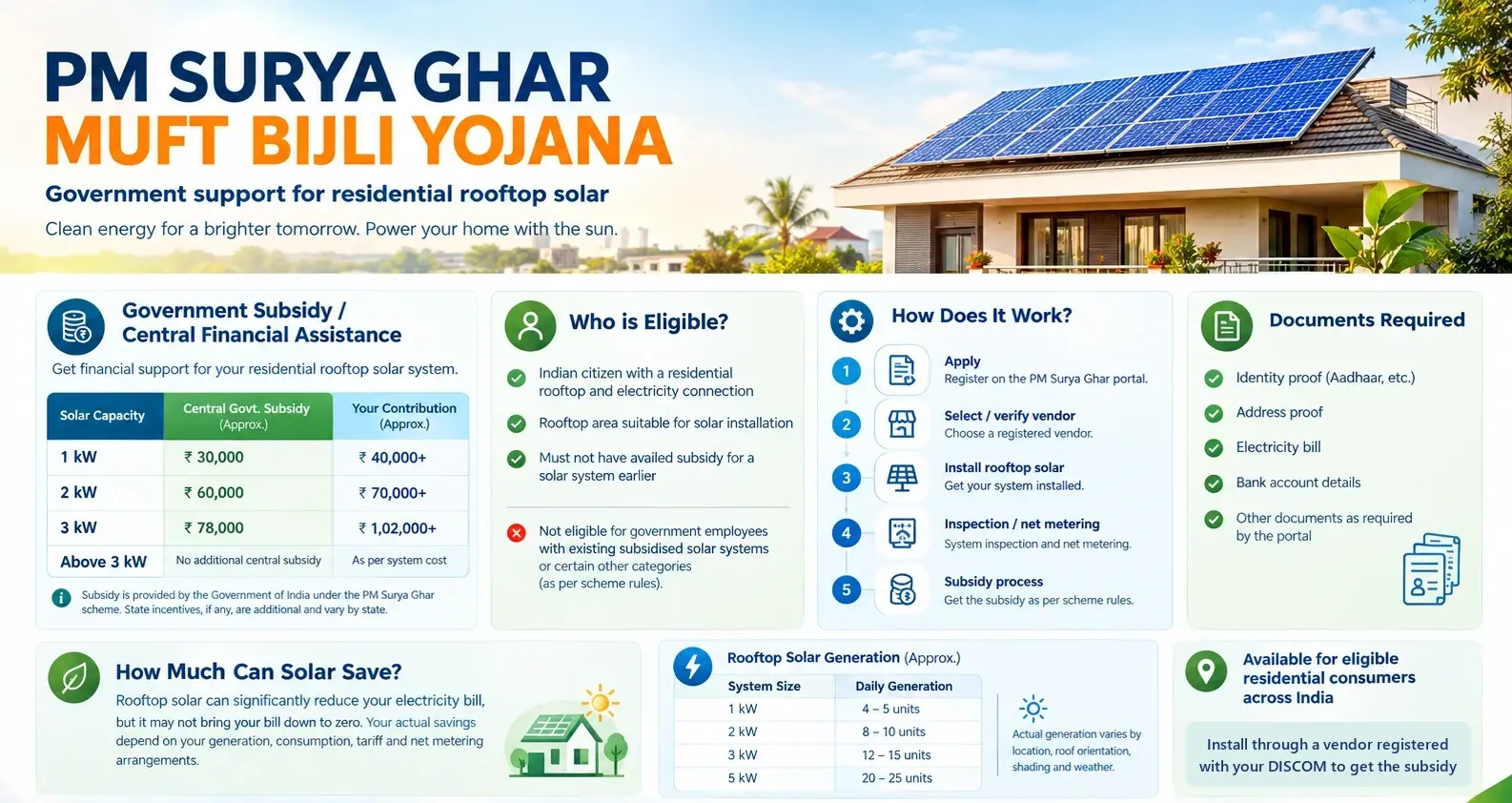
What the scheme is
PM Surya Ghar: Muft Bijli Yojana is a Government of India programme providing central financial assistance towards residential rooftop solar. It is a reimbursement: you have the system installed and commissioned, and the subsidy is credited to your registered bank account afterwards.
Two conditions matter more than any other, because they are where claims fail. First, the system must be grid-connected with net metering — the arrangement that lets exported solar units offset what you draw from the grid (see how import and export units work). Second, the installation must meet the technical standards set by MNRE (the Ministry of New and Renewable Energy) and your DISCOM, the electricity distribution company for your area. Both conditions are locked in at the design stage, before any equipment is bought — which is why getting the specification right up front is what actually decides whether the subsidy arrives.
Eligibility rules, current subsidy amounts and the official application route are published by the Government of India on the PM Surya Ghar portal. That portal is the authority; anything you read elsewhere, here included, is a summary of it.
This page covers residential rooftop electricity systems only. An agricultural pump falls under a separate scheme, PM-KUSUM, not this one — see our solar water pumping page for its current status.
PM Surya Ghar's current implementation period, under the scheme's original 2024 cabinet approval, runs through 31 March 2027. What happens beyond that period has not been announced, so we are not going to speculate on it here — the practical takeaway is that eligibility, approvals and timelines are all easier to plan around the earlier you start.
How much solar subsidy can you get
PM Surya Ghar: ₹30,000 for 1 kW, ₹60,000 for 2 kW, ₹78,000 for 3 kW and above (capped at 3 kW).
This is the central subsidy only. Some states run their own additional incentive on top of it; Telangana and Andhra Pradesh do not currently have one confirmed, so treat the figure above as the total unless we tell you otherwise for your specific application.
These amounts and the capacity bands are set by government notification and can change. The PM Surya Ghar portal is the authoritative source at the time you apply.
How much electricity will the system generate
EstimatedRoughly 1,550–1,600 kWh per kW per year, derived from Origian's own installed base in the Anantapur (APSPDCL) region: a 3 kW system averaging ~400 kWh/month and a 5 kW system averaging ~650 kWh/month.
Multiply that by your tariff slab and you have the annual saving the subsidy is being measured against. For a worked figure using your own bill rather than a regional average, use the rooftop solar savings calculator.
Estimate your own subsidy and cost
The two calculators below use the confirmed subsidy amounts above and your own bill or capacity, not a generic figure. Neither asks for contact details before showing a result.
How the application actually runs
Step 1
Register on the national portal
You register as a consumer with your DISCOM name, consumer number and contact details. This creates the application that everything else attaches to.Step 2
Apply for feasibility approval
Your DISCOM checks that your connection and the local network can take the proposed system. Nothing should be purchased before this clears.Step 3
Have the system installed
Installation is carried out against the approved capacity and specification. Deviating from what was approved is the most common cause of a rejected claim.Step 4
Submit for inspection
Installation details and photographs are submitted, and the DISCOM inspects the completed system.Step 5
Net meter installed and commissioned
A bidirectional meter is fitted and the system is formally commissioned. A commissioning certificate is issued.Step 6
Subsidy credited
Bank details and the commissioning certificate are submitted through the portal, and the subsidy is credited to the registered account.
Origian Power handles steps 2 through 6 as part of the installation, and prepares the documentation each stage requires.
Where applications usually go wrong
The eligibility criteria are not the hard part. These are the failures we see:
- Buying before feasibility approval. If the DISCOM approves a smaller capacity than you installed, the excess is not subsidised.
- Equipment that does not meet the standard. Modules and inverters must meet the scheme’s technical requirements. Cheaper equipment that misses them disqualifies the whole claim.
- A mismatch between the connection and the applicant. The electricity connection, the property and the bank account need to line up. Inherited or jointly-held property is where this most often breaks.
- Stalling at the net-metering stage. The meter change is a separate DISCOM workflow and does not progress on its own.
Documents typically required
The portal itself sets the exact requirements, but a domestic application typically needs: a recent electricity bill (for the consumer number and DISCOM name), proof of ownership or right to install on the property, an Aadhaar-linked bank account for the subsidy credit, and the equipment and installer details once a vendor is selected. Origian collects and submits these as part of the application rather than handing you a checklist to manage yourself. One detail worth knowing before equipment is finalised: not every panel qualifies for this subsidy regardless of brand or price — see DCR vs non-DCR panels, and what they mean for your subsidy.
PM Surya Ghar in Andhra Pradesh
In Andhra Pradesh the application runs through APSPDCL, APEPDCL or APCPDCL, depending on which one supplies the property. Our confirmed generation data (above) comes from Origian’s own installed base in the Anantapur/APSPDCL region, where we also have a local office — see solar installation in Anantapur for real, named installations we’ve completed there.
PM Surya Ghar in Telangana
In Telangana the application runs through TGSPDCL or TGNPDCL, depending on which one supplies the property. We have two offices in Hyderabad — see solar installation in Hyderabad for details. Our confirmed generation figures above are from our Anantapur installed base specifically and have not yet been separately measured for Telangana; we will give you a Telangana-specific estimate at survey rather than assume it matches Andhra Pradesh exactly.
What Origian does for your application
We prepare and track the application, specify the system so that it satisfies the technical requirements, submit the documentation at each stage, and follow the DISCOM through feasibility, inspection and the net-metering change.
The portal itself is free to use; what you are paying for is getting the four failure points above right the first time — the capacity matching what the DISCOM approved, equipment meeting the technical standard, the connection and applicant lining up, and the net-metering step not stalling once the system is in.
The scheme applies to grid-connected residential rooftop systems, so if you have not already decided on a configuration, start with how Solar On-grid works, that is the setup the subsidy is designed around. For what a system costs before any subsidy, see our solar system prices.
- Typical approval timeline: Typically 10 to 15 days in both Telangana and Andhra Pradesh. The main cause of delay is stock availability, not the approval process itself.

Reviewed by Sohith Jaidev, Managing Director — 10 years in solar power.
Common questions
What is PM Surya Ghar: Muft Bijli Yojana?
PM Surya Ghar is the Government of India scheme that provides a central financial assistance subsidy on residential rooftop solar photovoltaic systems. Launched in 2024, it runs through the national PM Surya Ghar portal rather than through individual DISCOMs, though the DISCOM still carries out feasibility approval, inspection and net metering as part of the same overall process. The subsidy is not a loan and is never repaid: it is a direct credit paid into the homeowner's registered bank account once the system has been installed, inspected and commissioned with net metering in place. It applies specifically to grid-connected residential rooftop solar, which distinguishes it from state-level incentives or commercial-sector schemes that may exist separately. Because the amount and eligibility rules are set by government notification rather than by any installer, the PM Surya Ghar portal remains the single authoritative source for the current terms at any given time.
Who is eligible for the PM Surya Ghar subsidy?
In broad terms it is for Indian residential electricity consumers who own the property or hold the right to install on its roof, who have a valid domestic electricity connection registered in their name, and who have not already claimed a rooftop solar subsidy for that same connection. The scheme applies to residential premises specifically, not to commercial or industrial ones — a shop, office or factory roof does not qualify even if the building also contains a residence, unless the electricity connection itself is classified as domestic. Ownership does not need to mean sole ownership: a property held jointly, or by a family member, generally still qualifies provided the applicant has the right to install on the roof and the bank account used for the subsidy payout belongs to someone named on that connection.
How much subsidy will I get?
Central financial assistance is banded by system capacity, with the subsidy rate stepping down as capacity increases and a firm cap above a certain size — larger systems receive proportionally less support per kW than smaller ones, which is a deliberate design to make the scheme reach more households rather than subsidise the largest installations most heavily. The amounts are set by government notification and change from time to time as policy is revised, so the figures worth relying on are always the ones currently published on the PM Surya Ghar portal at the moment you apply, not a number quoted by an installer or seen on another website, including this one. Check the current banding on the portal yourself before relying on any figure.
Does the subsidy apply to off-grid or hybrid systems?
No. PM Surya Ghar applies only to grid-connected residential rooftop systems with net metering — the scheme's entire structure, from the feasibility check through to the subsidy payout, assumes a live connection to the DISCOM's grid. A hybrid system with battery backup may still qualify for the grid-connected portion of the subsidy depending on exactly how it is configured and metered, since the battery itself sits alongside the net-metered connection rather than replacing it. A standalone off-grid installation, with no grid connection or net meter at all, falls outside the scheme entirely regardless of capacity or cost, because there is no DISCOM-administered process for the government to attach the subsidy to in the first place. If you are weighing off-grid against a grid-connected system partly because of the subsidy, that alone is a strong argument for staying grid-connected wherever a reliable connection already exists, since it is the difference between qualifying for real government support and receiving none at all.
Is PM Surya Ghar the same as PM-KUSUM?
No, and confusing the two is a common and costly mistake. PM Surya Ghar is for residential rooftop electricity systems, administered through the national portal and each connection's DISCOM. PM-KUSUM is a separate central scheme aimed at solar in agriculture — standalone irrigation pumps and the solarisation of existing grid-connected pumps — administered through state nodal agencies rather than the PM Surya Ghar portal, with its own eligibility rules built around farm ownership and pump capacity rather than a residential electricity connection. It is not currently open for new applications in either Telangana or Andhra Pradesh, so a farm pump installed today is not subsidised under either scheme at present; ask us for the current status before assuming either one applies to an agricultural installation. The two schemes are frequently mixed up in casual conversation and even in some vendor marketing, which is worth being alert to if you are comparing quotes for a farm installation against quotes for a home rooftop system, since the eligibility rules, application portal and even the administering authority are entirely different between them.
When is the subsidy actually paid?
After commissioning, not before. The system must be installed, inspected by the DISCOM and running with a bidirectional meter in place, after which the subsidy is credited directly to the bank account registered in the application — there is no partial or advance payment at any earlier stage. You pay the full system cost up front, out of your own funds or financing, and are reimbursed only once every step of the government's verification process has been completed and signed off. This sequencing exists so the subsidy is paid against a system that demonstrably exists and works, rather than against a paper application, which is also why delays in DISCOM inspection or net-metering setup translate directly into delays in when the money actually arrives. Budgeting for the full system cost up front, rather than assuming the subsidy will offset the initial payment, is worth building into your financing plan from the start — a home loan or solar-specific financing product bridges this gap for many households rather than the subsidy itself doing so.
Can I apply for the subsidy myself?
Yes. The portal is open to consumers directly and the initial registration process is straightforward, typically taking only a few minutes with basic details about your electricity connection and roof. Where applications typically stall is not registration but the technical stages that follow it: getting DISCOM feasibility approval for your specific site, scheduling and passing inspection, and completing the net-metering change on your connection — steps that involve site-specific technical judgement rather than form-filling, and where an experienced installer's familiarity with your local DISCOM's process genuinely speeds things up. Most homeowners who apply themselves still end up relying on their installer for these later stages even if they handled the initial registration independently, since the technical stages require submitting site drawings, single-line diagrams and equipment specifications in the format each DISCOM expects, which is routine work for an installer but unfamiliar territory for a first-time applicant.
Can I install a 5 kW system and still get the subsidy?
Yes, but the subsidy itself is capped at the 3 kW-and-above band, so a 5 kW system receives exactly the same central assistance as a 3 kW one once you cross that threshold — the additional 2 kW of capacity is funded entirely by you, at whatever return that extra generation delivers on your own bill. This matters because it changes the economics of sizing up: past the subsidy cap, every additional kW is a pure investment decision weighed against your actual consumption, not a way to draw more government support. Sizing past 3 kW is worthwhile when your household genuinely uses that much power — it is not, on its own, a reason tied to the subsidy. A useful way to check this before committing to a larger system is to look at your own recent bills for months with the heaviest consumption, since those months show what your system actually needs to cover rather than an average that understates your real peak load.
Can tenants apply for PM Surya Ghar?
Only with the property owner's consent. The scheme requires the applicant to own the property or hold the right to install solar on its roof, and the electricity connection, the property records and the subsidy bank account all need to align for the application to go through — which in practice means the owner is part of the process even if a tenant is the one who initiates it or coordinates with the installer day to day. This is less about excluding tenants outright and more about the government needing a clear, verifiable link between the person receiving the subsidy and the property the system sits on, since the subsidy attaches to the physical installation rather than to whoever happens to be living there at the time. In practice this means a tenant interested in solar should raise it with their landlord early, since the owner's cooperation is needed not just for the subsidy application itself but for any structural work on the roof, which typically requires the owner's consent regardless of the subsidy scheme.
Can I get the subsidy on an existing solar installation?
No. PM Surya Ghar is structured around a new installation going through DISCOM feasibility, inspection and net-metering as one continuous application — there is no mechanism in the scheme for retroactively subsidising a system that was already commissioned outside that process. A connection that has already claimed a rooftop solar subsidy under this or an earlier scheme cannot claim it again for the same premises, even if the original installation is later expanded or upgraded. If you have an existing solar system without net metering and are considering adding capacity, that addition would generally need to be treated as its own separate feasibility and application process rather than an extension of what is already there. It is worth checking your own records or asking your original installer whether any subsidy was claimed for your existing system before assuming you are still eligible, since the DISCOM's own records are what ultimately determine eligibility rather than your own recollection of what was applied for.
Can PM Surya Ghar make my electricity bill zero?
Usually not entirely, even with a well-sized system matched carefully to your consumption. Fixed charges, demand charges and statutory levies are generally billed against your connection itself rather than against how much electricity you actually draw, so they continue to appear on your bill regardless of how much solar you generate or export. Solar reduces the energy component of the bill — the part tied directly to units consumed, and the largest single line for most households — often substantially, but a quotation promising a literal zero bill afterwards is describing only that one component and leaving the fixed charges out of the picture entirely. Ask to see the fixed-charge breakdown on your own bill before assuming a zero-bill claim applies to your specific connection, since the proportion fixed charges make up of the total bill varies noticeably between DISCOMs and connection categories, and a genuinely near-zero outcome is realistic for some households while being unrealistic for others on the exact same system size.
How much does solar cost after the subsidy?
That depends on the system cost, which varies by equipment choice, roof condition and site-specific factors like shading or roof access — we deliberately do not publish a single fixed figure here because it would be misleading for most individual properties, and a number that looks attractive in an advertisement often does not match what a real site actually needs. Use the calculators above with your own recent electricity bill: they subtract the currently confirmed subsidy amount from an estimate built specifically around your actual consumption pattern, rather than around a national or regional average that may bear little resemblance to your household. The result is still an estimate, not a quotation, but it is one grounded in your own numbers rather than an industry-wide figure that assumes away exactly the variation that determines what your installation would really cost.
When does PM Surya Ghar end?
The scheme's current implementation period, under its original 2024 cabinet approval, runs through 31 March 2027. What happens after that date has not been officially announced by the government, so treat any confident claim of a hard cutoff — including anything stated elsewhere on this page — with appropriate scepticism until an official notification says otherwise. What is true regardless of how the scheme eventually evolves: DISCOM approval, inspection and net-metering setup all take real time to complete, typically some weeks from start to finish, so applying earlier in the scheme's window gives more room for that process to run its full course without racing against an eventual deadline or capacity limit. If the scheme were to close to new applications at some point, the practical effect would fall hardest on whoever is mid-process when that happens, which is a real argument for starting sooner rather than waiting for more clarity that may not arrive before any changes take effect.
How long does the DISCOM approval process take?
Typically 10 to 15 days, in both Telangana and Andhra Pradesh, from feasibility approval through to commissioning, though this can vary by DISCOM workload and site specifics. The sequence generally runs: DISCOM reviews and approves feasibility for your specific site and connection, a technical inspection visit confirms the installed system matches what was approved, the net meter is swapped in to replace the existing one-way meter, and commissioning sign-off follows once the meter change is verified. The main cause of delay we see in practice is equipment stock availability on the installer's side rather than the DISCOM approval process itself. The subsidy is credited only after this entire sequence — installation, inspection and net metering — is fully complete; see "When is the subsidy actually paid?" above. If your timeline matters for a specific reason, such as coordinating with a home loan disbursement or a seasonal consumption pattern, it is worth raising that with your installer before the application goes in, since scheduling the inspection visit around a known constraint is far easier than trying to compress the process once it is already underway.
Which DISCOM handles my PM Surya Ghar application?
Whichever one supplies electricity to your specific property, not a choice you make yourself. In Andhra Pradesh that is APSPDCL, APEPDCL or APCPDCL depending on the region your connection falls under; in Telangana it is TGSPDCL or TGNPDCL depending on the district. Each DISCOM runs its own feasibility approval and inspection process on broadly similar timelines but with its own local quirks in paperwork and scheduling. You do not need to work out which one applies to your connection yourself — Origian identifies the correct DISCOM from your existing electricity bill or connection details and submits the feasibility, inspection and net-metering applications through it directly as part of the installation, so this is handled on your behalf from the start. This matters in practice because each DISCOM has its own submission portal, document format and typical response time, and an installer with direct experience of your specific DISCOM's process avoids the trial-and-error that a first-time applicant working from generic guidance would otherwise face.
What is the best solar system size to install under PM Surya Ghar?
Not necessarily the size that draws the maximum subsidy. The central assistance caps at the 3 kW-and-above band, so a household consuming enough to justify a 5 kW system receives the same capped amount whether it installs 3 kW or 5 kW — the extra 2 kW of capacity is funded entirely at your own cost, for your own return on the additional generation, with no additional subsidy attached to it. The size actually worth installing is the one your real consumption supports, which is what the subsidy calculator and savings calculator on this site work out from your own electricity bill, rather than defaulting to whichever size happens to sit at the subsidy cap simply because that is where government support stops increasing. Treating the subsidy cap as a sizing target rather than a funding detail is a common mistake we see among first-time buyers comparing quotes, and it tends to produce systems that are either oversized for genuinely light users or undersized for households with real daytime consumption from air conditioning or heavy appliances.
Technical terms explained
DISCOM
Your electricity distribution company: the one that supplies your property and issues your bill. In Telangana it is TGSPDCL or TGNPDCL; in Andhra Pradesh it is APSPDCL, APEPDCL or APCPDCL, depending on where you are. Your bill shows which one.
Net metering
A bidirectional meter that counts units you draw from the grid and units your system exports to it, so exported solar units offset what you import. The scheme only applies to systems with net metering.
Feasibility approval
Your DISCOM's sign-off that your specific site and connection can take the proposed system. It is the first technical stage after registration, before installation.
Commissioning
The final sign-off once the DISCOM has inspected the installed system and the net meter has replaced your old one-way meter. The subsidy is credited only after this step.
Central financial assistance
The formal name for the PM Surya Ghar subsidy. It is a reimbursement paid into your bank account, not a loan, and it is never repaid.
Questions about the subsidy?
Tell us your DISCOM and your monthly bill. We will explain how the scheme works and what it means for your plans. Origian Power is not a registered PM Surya Ghar vendor, so we do not file subsidy applications.